Even the Stones Will Cry Out: Rethinking Apostolic Succession from the Fields
By +Brian Ernest Brown, CWC
Every few years, the dust gets kicked up again in the Independent Sacramental Movement, and good folks start wringing their hands over the same old anxiety: Are we valid?
We watch bishops frantically dusting off old papers, tracing lineage back through Arnold Harris Matthew or René Vilatte or some other bishop of celebrity, trying to prove their ecclesiastical pedigree like prize-winning show dogs. Then comes the inevitable gut-punch: an official voice from Rome, Canterbury, Constantinople, or an academic treatise from Utrecht citing venerable Latin maxims like nullus episcopus sine ecclesia “no bishop without a church” declaring that because we don’t sit in their historic cathedrals, hold their institutional mandates, or carry their stamped paperwork, our sacraments are null and our ordinations are mere dress-up.
When apostolic succession is reduced to legalistic plumbing, a mechanical pipeline of magic fingers and bureaucratic authorizations, the living Gospel is traded for tedious ink, paper, and fancy stamps. The historic episcopate was never intended to be an exclusive guild guarding institutional franchises. Grounded in the Gospels, authentic apostolicity is not defined by juridical recognition or mechanical lineage alone, but by fidelity to Christ’s mission, the fruit of the Spirit, and pastoral presence among God’s people.
The critique out of Europe, crystallised in Bishop Urs Küry’s textbook Die Altkatholische Kirche, claims that without an established canonical parish structure, an election by an organized church, and formal ecclesiastical missio, episcopal consecration is void. Utrecht looks across the Atlantic at storefront missions, chapel communities, and itinerant ministries and dismisses them as ecclesiastical adventurers lacking authentic Catholic orders.
Yet this institutional anxiety ignores church history. Rome applied the exact same charge of invalidity and illegitimacy to Utrecht for centuries; Canterbury faced the same rejection via Apostolicae Curae; Eastern Orthodoxy and Western Catholicism have repeatedly questioned each other’s sacramental fullness based on conflicting ecclesiological presuppositions. Whenever an institution mistakes its boundaries for the borders of the Kingdom of God, it constructs legal tests to delegitimize any grace it cannot regulate.
When the independent movement responds by obsessively compiling lineage charts, seeking conditional reconsecrations, or chasing intercommunion concordats to win institutional validation, it plays by the exact rules that exclude it. It adopts a mechanistic theology where grace flows through bureaucratic stamps rather than through the call of Christ and the communion of the faithful.
To recover a healthy understanding of validity, we must return past canon law, past medieval scholasticism, and past the imperial models of church order directly to the testimony of Jesus in the Gospels. Four key passages dismantling the proprietary control of ministry provide our foundation:
+ The Gospel of Mark 9:38-40
When the Apostle John approached Jesus complaining, “Teacher, we saw someone casting out demons in your name, and we tried to stop him, because he was not following us,” he voiced the classic institutional reflex: ministry conducted outside the recognized circle cannot be legitimate.
Jesus answered unequivocally: “Do not stop him; for no one who does a deed of power in my name will be able soon afterward to speak evil of me. Whoever is not against us is for us.”
Christ explicitly rejected the idea that ministry must belong to the recognized inner circle to be authentic. The man in Mark 9 lacked institutional authorization, had no formal missio from the Twelve, and carried no canonical mandate. Yet because he operated in the name and power of Jesus, Christ declared his work legitimate. Validity in the Kingdom is determined by alignment with the liberating work of God, not by membership in a closed roster.
+ The Gospel of Matthew 7:15-20
When addressing how the community must discern between true and false shepherds, Jesus offered a single, objective criterion:
“You will know them by their fruits. Are grapes gathered from thorns, or figs from thistles? In the same way, every good tree bears good fruit, but the bad tree bears bad fruit.”
Notice what Jesus did not say. He did not say, “You will know them by their canonical election,” nor “You will know them by their letters of communion from Rome, Canterbury, Constantinople, or Utrecht.”
A branch grafted onto an ancient root that yields only the rotten fruit of cover-ups, clerical abuse, institutional greed, and exclusion has severed itself from the apostolic spirit. Conversely, where an independent priest or bishop celebrates the Eucharist over a card table in a hospice wing, anoints the dying, feeds the unhoused, and gathers those cast out by mainstream communion rails, the fruit of the Holy Spirit: love, joy, peace, kindness, and faithfulness, is made visible. Where the fruit of the Spirit is present, the Spirit is present; and where the Spirit is present, the Church is alive.
+ The Gospel of John 21:20-22
Following His resurrection, Jesus commissioned Peter to feed His sheep. Almost immediately, Peter turned, looked at the Beloved Disciple, and asked the perennial bureaucratic question: “Lord, what about him?”
Jesus replied with sharp clarity: “If it is my will that he remain until I come, what is that to you? Follow me!”
The temptation to gaze sideways, worrying about how another jurisdiction functions, whether their line is purer, or whether they consider our orders authentic, is a distraction from following Christ. Peter was assigned one pastoral task; the Beloved Disciple held another witness. The Independent Sacramental Movement does not exist to justify its existence to Peter’s successors, nor to Utrecht’s synods. Christ’s charge to the independent bishop and cleric remains unchanged: What is that to you? Follow me into the field.
+ The Gospel of Luke 19:36–40
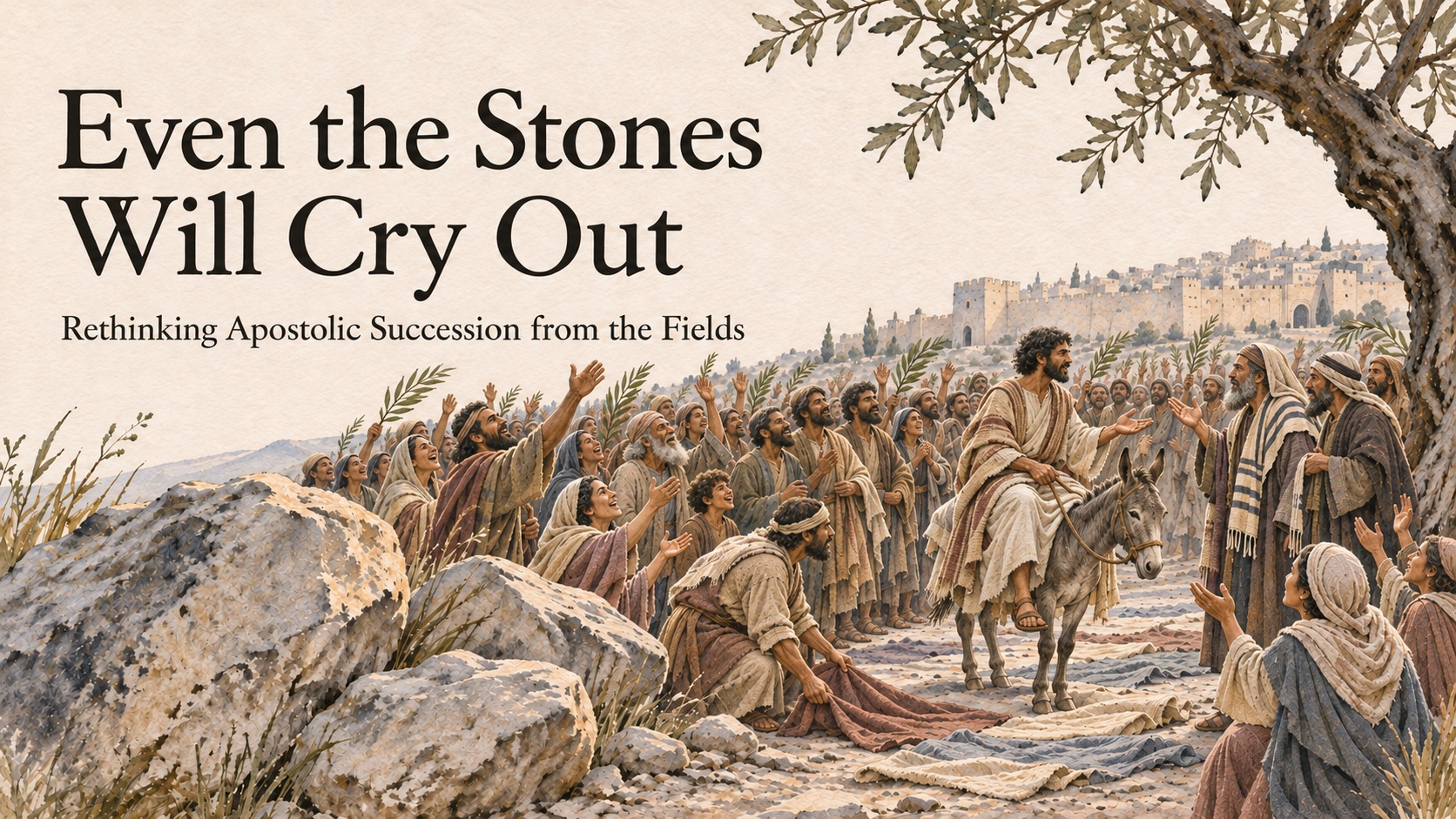
As Jesus made His triumphal entry into Jerusalem, the disciples and the crowd rejoiced loudly, praising God for the mighty works they had witnessed. The Pharisees in the crowd demanded that Jesus exercise institutional control: “Teacher, order your disciples to stop.”
Jesus answered:
“I tell you, if these were silent, the stones would shout out.”
The Independent Sacramental Movement exists largely because institutional churches closed their doors to people who did not fit their dogma, their marital requirements, their racial barriers, or their gender and sexual expectations. When established institutions refuse to minister to the marginalized, God does not abandon them. God raises up the stones in the ditch. The independent cleric is called to be that stone, an unconventional, rough-hewn instrument shouting out the mercy of God when the organized assemblies demand silence.
Apostolic succession is not a line drawn on paper; it is a life lived in service. The ancient formula nullus episcopus sine ecclesia is true, but an “ecclesia” is not defined by municipal property deeds, canonical incorporation, or membership in ecumenical councils. Wherever two or three are gathered in Christ’s name, there is the Church. Wherever a bishop shepherds the scattered, baptizes the seekers, and breaks the bread of life among those whom the world overlooks, there is a bishop with a church.
Lineage matters as an expression of historical continuity and humble solidarity with the historic Church, but it is the scaffolding, not the temple. The validity of our holy orders does not depend on whether a primate in Europe or an archbishop in Rome acknowledges our paperwork. It rests on whether Christ meets His people at our altars, whether the broken are healed by our pastoral care, and whether the Gospel is preached without fear or favor.
Let the institutions guard their gates and count their pedigree papers. Our calling is to roll up our sleeves, walk out into the field where the harvest is ripe and the laborers are few, and simply be the Church.
That being said, if we’re going to speak prophetically about the failures of historic churches, we owe our own movement the same searching examination. One of our most serious weaknesses is the uneven quality of spiritual, theological, and psychological formation at every level of ordained ministry. When we treat apostolic succession as little more than the transmission of holy orders, we make it too easy to ordain people before they’re ready to care for souls. That work calls for disciplined prayer, serious theological study, supervised pastoral and clinical training, and time in a community that knows a candidate well enough to test their character. The people who will one day turn to us in grief, in crisis, or in matters of conscience have a right to expect that we’ve done this work.
Where oversight is weak and the people have little voice, the episcopate can become a place to seek recognition and gather authority. A title and a set of vestments can lend the appearance of maturity to someone who still struggles to hear a word of correction. We’ve seen what happens when every disagreement can be settled by founding another jurisdiction, and every new jurisdiction needs another bishop. The people are left to bear the cost of divisions their shepherds had a duty to work through. The early Church’s understanding of holy orders calls us back to the cross. For a bishop, dying to self can mean staying at the table when we’d rather walk away, hearing the truth from someone we’ve hurt, and yielding authority when the good of the people requires it. Those are among the fruits by which our claim to apostolic ministry will be known.
The freedom we claim as independent sacramental Christians puts a responsibility squarely in our hands. We can take longer to prepare people for ordination. We can give the faithful a real voice in the life of their churches and the means to call their bishops to account. We can stay at the table when a quarrel would be easier to settle by walking away. And where we’ve wounded people, we can tell the truth about what happened, ask forgiveness, and do the work of repair. By the grace of God, we can become a movement whose people have good reason to trust their shepherds.
We can receive a word of correction from the historic churches and be grateful for it. We can pray with them and work beside them wherever Christ gives us the chance. And we can get on with the work God has given us with a settled heart. When Peter looked over his shoulder and asked Jesus about the other disciple, the Lord brought him back to his own calling. “Follow me.” I hear those words for us. There’s a neighbor waiting for someone to visit, a person who’s been turned away from Communion wondering whether it’s worth trying one more church, and a little congregation that needs a pastor who’ll stay. Christ has already given us somewhere to go.
So let’s be who God has called us to be. Let’s form ministers who know how to pray, how to listen, and how to be corrected. Let’s keep a place at the table for the people who’ve learned to expect a closed door. Let’s break the Bread of Life in the places where people are hungry and carry it to those who can’t come to us. And when the day comes for someone to tell the story of our little corner of the Church, may it be told by people who can say with the disciples on the road to Jerusalem that they saw the mighty works of God with their own eyes. And if our voices fail us, well then, even the stones will cry out.